

CONTRIBUTORS

Nicholas Hardingham, CFA
Portfolio Manager, Franklin Templeton Fixed Income

Stephanie Ouwendijk, CFA
Portfolio Manager, Research Analyst, Franklin Templeton Fixed Income
Emerging market debt (EMD) has become a common allocation for institutional investors seeking enhanced yield and diversification. Often allocations are through benchmark-driven approaches, which can limit the ability of investors to fully harness the opportunities available.
Key takeaways
- Flawed benchmarks: Popular EMD indices focus on larger, more developed countries, leading to concentration risk, suboptimal yields, and limited diversification.
- Expanding horizons: A more forward-looking approach could include selective exposure to frontier markets, local currency bonds, and corporate debt.
- Better outcomes: Broadening the EMD universe can enhance diversification, improve yield, and reduce downside risk.
Introduction: Rethinking the blueprint for EMD
Emerging market debt (EMD) has become a staple allocation for investors looking to enhance diversification and yield. However, relying on benchmark-driven strategies often undermines these goals. Active managers are frequently constrained by benchmarks, and passive strategies based on debt-weighted indices tend to overemphasize larger, developed markets, leaving valuable opportunities untapped.
One major concern is concentration risk. For example, over 60% of the JP Morgan EMBI Global Index is allocated to just 10 countries. This limits exposure to smaller, less efficient markets where active managers could potentially generate higher alpha.
Furthermore, many indices exclude crucial segments, such as frontier markets, local currency bonds, and corporate debt, which restricts investors from fully tapping into the growth potential of emerging markets. These indices also tend to have a higher proportion of investment-grade bonds, which results in lower yields and underrepresents higher-yielding opportunities.
To address these limitations, we propose a more expansive blueprint that includes frontier markets, local currency bonds, and corporate debt. This broader approach should enhance diversification, improve yield, and reduce downside risk.
Frontier markets: Selective opportunities for growth
Often seen as riskier, frontier markets (FMs) are frequently underutilised by investors. However, when thoughtfully integrated into broader EMD strategies, they can offer significant advantages. Over the long term, FM bonds have outperformed their emerging market counterparts, benefiting from unique structural characteristics that can reduce drawdown risks.
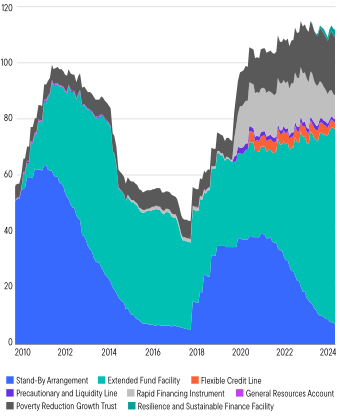
Risk concerns are further mitigated by the robust support these economies receive during times of global stress. For example, during the Covid-19 pandemic, the International Monetary Fund (IMF) acted as a lender of last resort to many frontier economies. Additionally, financing initiatives from multilateral organisations have helped strengthen FMs' credit profiles and address short-term liquidity challenges (see chart below).
This combination of performance potential and external support makes frontier markets a strategic addition to EMD portfolios. By adopting a selective approach, investors can tap into higher returns while managing risk effectively.
Exhibit 1: Frontier Markets Have More Finding Options to Avoid Default
IMF Lending Data by Financing Vehicle (US$bn)
Source: International Monetary Fund, as of 9/30/2024.
Currencies: Don’t overlook their return potential
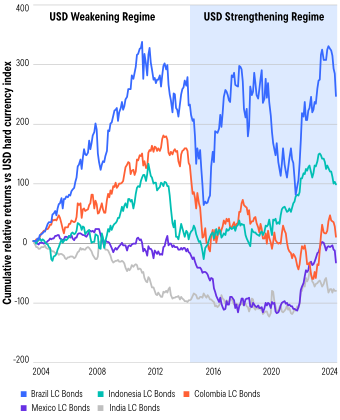
EMD indices typically focus on US dollar-denominated bonds, which implicitly exposes investors to a single long ‘bet’ on the US dollar. While this approach has delivered strong returns over the past decade due to dollar strength, history shows the opposite can occur during periods of dollar weakness, as experienced from 2004 to 2014.
Expanding EMD allocations to include local currency bonds can mitigate this risk, while offering diversification and return potential. Although local currency bonds have historically lagged hard currency bonds, individual country performance often varies significantly (see chart below). This variability enables skilled managers to uncover attractive opportunities, making local currency bonds a valuable addition to a well-rounded EMD strategy.
Exhibit 2: Selectivity Is Key to Investing in Local Currency Bonds Across Regimes
Relative Returns of Local Currency Bonds versus EMBI Global Diversified Hard Currency Index
Source: JP Morgan, as of 9/30/2024. Past performance is not necessarily indicative nor a guarantee of future performance.
Corporate debt: Diversify beyond sovereign debt
While many EMD portfolios are concentrated in government-backed securities, corporate debt has seen remarkable growth and is now one of the largest segments of the global bond market, with over $13.9 trillion1 in outstanding issuance.
EM corporate debt provides exposure to structural growth themes, such as digitalisation, urbanisation, and rising consumer demand in emerging markets. Additionally, corporate bonds tend to be more liquid and diversified by sector, issuer, and country. They also offer lower interest rate sensitivity and higher credit quality compared to sovereign bonds (see chart below), thanks to diversified revenue streams and lower debt levels.
Incorporating corporate debt into EMD allocations can enhance yield potential, while reducing overall portfolio risk.
Exhibit 3: EM Corporate Bonds Can Broaden Diversification, Lower Duration, and Improve Quality
Index Characteristics
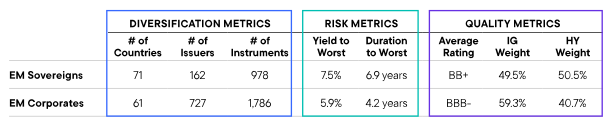
Source: JP Morgan, as of 9/30/2024. EV Sovereigns is represented by the JP Morgan EMBI Global Diversified Index. EM Corporates represented by the JP Morgan CEMBI Broad Diversified Index.
Conclusion: Creating a better EMD blueprint
The limitations of traditional EMD benchmarks have prompted some institutional investors to consider better strategies for improving outcomes. By expanding the investable universe to include frontier markets, local currency bonds, and corporate debt, we believe that investors can benefit from improved diversification, higher yield potential, and reduced downside risk.
Rather than relying solely on conventional benchmarks, we advocate for a more expansive, dynamic approach to EMD investing. This strategy can offer a larger opportunity set, supporting better long-term results while strengthening downside protection.
Strategy Profile: Franklin Emerging Market Debt Opportunities Strategy
The strategy seeks a total return by investing mainly in debt obligations of sovereign, quasi-sovereign and corporate issuers located in emerging market countries.
- Total return approach: Investments are not constrained by a benchmark. We only investing in countries and securities that are attractive.
- Broad opportunity set: The investment universe includes currencies, sovereign, quasi-sovereign, and corporate issuers. The strategy invests in debt that is denominated in all hard currencies as well as local currencies
- Experienced team: Managed by an experienced and deeply resourced team which has been investment in emerging market debt since 1996.
Endnotes
- Source: JP Morgan, as of 31/12/2023.
WHAT ARE THE RISKS?
All investments involve risks, including possible loss of principal.
Fixed income securities involve interest rate, credit, inflation and reinvestment risks, and possible loss of principal. As interest rates rise, the value of fixed income securities falls.
International investments are subject to special risks, including currency fluctuations and social, economic and political uncertainties, which could increase volatility. These risks are magnified in emerging markets. Investments in companies in a specific country or region may experience greater volatility than those that are more broadly diversified geographically.
The government’s participation in the economy is still high and, therefore, investments in China will be subject to larger regulatory risk levels compared to many other countries.
The allocation of assets among different strategies, asset classes and investments may not prove beneficial or produce the desired results.
Sovereign debt securities are subject to various risks in addition to those relating to debt securities and foreign securities generally, including, but not limited to, the risk that a governmental entity may be unwilling or unable to pay interest and repay principal on its sovereign debt.