

CONTRIBUTORS

Francis Gannon
Co-Chief Investment Officer, Managing Director
“We think the potential is high for a sustained period of strong small-cap performance on both an absolute and relative basis.”
We believe that current economic and investment conditions are creating potential advantages for active small-cap managers, with a particular edge developing for higher-quality small-cap companies.
The normalization of rates is already leading companies to make what we see as more rational capital allocation decisions—because balance sheets and financial leverage matter again. This is especially true in small-cap, with its high percentage of loss-making companies, and where debt tends to be more variable than fixed. In this context, a more historically typical interest rate era should reward successful operational performance—as opposed to financially engineered profits—and thus supports the potential for higher-quality businesses to outperform. We define high-quality businesses as those with low debt, the ability to generate free cash flow, high returns on invested capital, and management teams with proven skill at allocating capital prudently and effectively.
Within the Rusell 2000 Index—where the majority of passive small-cap index investments focus—43% of the constituents are loss-making companies, with many also having a relatively high degree of financial leverage. From a quality standpoint, actively managed small-cap portfolios look better positioned for success than the overall benchmark because active managers tend to prefer companies with attributes such as high—and consistent—returns on invested capital, low debt, free cash flow generation, and steady profitability.
All these developments may be setting the stage for above-average small-cap performance. As of 2/29/24, the Russell 2000 was down -13.0% from its last peak on 11/8/21. With rates stabilizing and the US economy growing, the potential for mean reversion potential appears very high. Moreover, the 3-year average annual total return for the Russell 2000 as of 2/29/24 was 0.9%. Why is this dismal return notable? In 66 of 67 periods—or 99% of the time—when the index’s 3-year average annual total return was 3% or lower, subsequent 3-year annualized returns were positive and averaged 16.7%—a significantly higher mark than the Russell 2000’s 10.7% monthly rolling 3-year average annual return since inception (12/31/78).
Small-caps had a peak to trough decline of more than 30% in the current cycle and in many cases have already discounted a recession that has yet to materialize. We are therefore expecting a sustained catch-up phase for small-caps as returns have fallen significantly below average on a 1-, 3-, 5-, and 10-year basis through the end of February.
Given these recent returns for the Russell 2000, it will probably come as no surprise that small-cap stocks remain undervalued on both an absolute basis and relative to large-cap stocks. What is less obvious is that select small-cap businesses continue to flash considerable earnings potential. As of 12/31/23, the weighted harmonic price-to-earnings ratio (“p/e ratio”) for the Russell 2000 was well below its historical average (14.9x versus 17.9x) while large cap traded at the substantially higher P/E of 23.3x at the end of 2023.
Small-Cap P/Es are Still Below Average
Weighted Harmonic Average Price-to Earnings Ratio (Excluding Non-Earners) for the Russell 2000
12/31/98-12/31/23
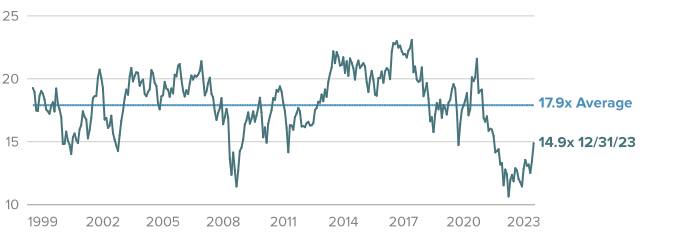
Source: FacstSet. Past performance is no guarantee of future results. The weighted harmonic mean is the preferable method for averaging multiples, such as the price–earnings ratio. If these ratios are averaged using a weighted arithmetic mean, high data points are given greater weights than low data points.
In a similar vein, we have written recently that relative valuations for small-caps relative to large-caps were near their lowest in 25 years as of 12/31/23 based on our preferred index valuation metric, enterprise value to earnings before interest and taxes, or EV/EBIT. Further, earnings growth for small-caps is expected to be double that of large caps in 2024—which is consistent with the mostly positive news that our portfolio management teams heard during February 2024’s earnings season.
Finally, we see a secular opportunity for active small-cap management. Small-caps have greater exposure to US economic activity. Many smaller companies will likely see powerful secular benefits from nascent trends in AI, reshoring, supply chain shifts, and deglobalization. The CHIPS Act and several infrastructure projects will also boost US-centric manufacturing activity, benefiting smaller companies. All these activities will take place against the favorable backdrop of falling inflation, narrowing credit spreads, and the high probability that the Federal Reserve will cut rates later in 2024. To be sure, we think the potential is high for a sustained period of strong small-cap performance on both an absolute and relative basis.
Definitions
The Russell 2000 Index is an index of domestic small-cap stocks that measures the performance of the 2,000 smallest publicly traded US companies in the Russell 3000 Index.
Enterprise value (EV) refers to the entire value of a company after taking into account both holders of debt and equity.
The EV/EBIT multiple is the ratio between enterprise value (EV) and earnings before interest and taxes (EBIT).
Price-to-Earnings Ratio is calculated by dividing a company’s share price by its trailing 12-month earnings-per-share (EPS) and also excludes companies with zero or negative earnings.
Earnings per share (EPS) is calculated as a company’s profit divided by the outstanding shares of its common stock. The EPS Growth Estimates are the pre-calculated mean long-term EPS growth rate estimates by brokerage analysts.
The CHIPS and Science Act (CHIPS Act) is a US federal statute enacted by the 117th United States Congress and signed into law by US President Joe Biden on August 9, 2022. The act provides roughly $280 billion in new funding to boost domestic research and manufacturing of semiconductors in the United States.
The Federal Reserve Board is responsible for the formulation of US policies designed to promote economic growth, full employment, stable prices, and a sustainable pattern of international trade and payments.
WHAT ARE THE RISKS?
All investments involve risks, including possible loss of principal. Past performance is no guarantee of future results. Please note that an investor cannot invest directly in an index. Unmanaged index returns do not reflect any fees, expenses or sales charges.
Equity securities are subject to price fluctuation and possible loss of principal.
Small- and mid-cap stocks involve greater risks and volatility than large-cap stocks.
Fixed-income securities involve interest rate, credit, inflation and reinvestment risks, and possible loss of principal. As interest rates rise, the value of fixed income securities falls.
International investments are subject to special risks including currency fluctuations, social, economic and political uncertainties, which could increase volatility. These risks are magnified in emerging markets.
Commodities and currencies contain heightened risk that include market, political, regulatory, and natural conditions and may not be suitable for all investors.
US Treasuries are direct debt obligations issued and backed by the “full faith and credit” of the US government. The US government guarantees the principal and interest payments on US Treasuries when the securities are held to maturity. Unlike US Treasuries, debt securities issued by the federal agencies and instrumentalities and related investments may or may not be backed by the full faith and credit of the US government. Even when the US government guarantees principal and interest payments on securities, this guarantee does not apply to losses resulting from declines in the market value of these securities.
Any companies and/or case studies referenced herein are used solely for illustrative purposes; any investment may or may not be currently held by any portfolio advised by Franklin Templeton. The information provided is not a recommendation or individual investment advice for any particular security, strategy, or investment product and is not an indication of the trading intent of any Franklin Templeton managed portfolio. Past performance does not guarantee future results.
Data and figures quoted in this article sourced from Russell Investments, Bloomberg and Reuters.
