

CONTRIBUTORS

Francis Gannon
Co-Chief Investment Officer, Managing Director, Royce Investment Partners

Chris Clark
Chief Executive Officer, Co-Chief Investment Officer & President, RFS
Were you surprised that small cap was able to hold and maintain its market leadership from the early April low?
Francis Gannon: Not really, no. I think we should look at history, which tells us that coming out of lows, small- and micro-cap stocks typically bounce back the best, which is what we saw from the low on April 8 through the end of 2025. I'm kind of just going to rely on history to answer that one.
Jim Harvey: It was a good run. It was sort of a low-quality driven rally, which is also typical historically. A lot of the micro-caps and lower quality stocks all performed very well coming out of that April bottom.
Francis Gannon: Which is typical, right? Given the long-term history, as well as what we know about the historical performance patterns of small- and micro-cap asset classes, this is kind of how they act coming out of bottoms.
Lauren Romeo: I think the key driver of the rally was a reversal of the fears that drove small-caps into bear market territory in the first place. April 8 was the point of peak pessimism. The market was assuming very high odds of a US recession due to the new tariff regime introduced on “Liberation Day.” As the subsequent tariff news flow turned more positive (for example, 90-day implementation pauses, preliminary trade deals with key trade partners on more favorable terms) and expectations about the economy recalibrated back toward growth, investor enthusiasm for small-caps was understandable as the asset class is often viewed as a proxy for the health of the economy given they generate roughly 80% of their revenue from the United States. The absolute and relative valuations of small-caps, and their earnings growth outlook, also remain more attractive compared to mid- and large-caps.
Chris Clark: I agree. I think the inflection of earnings growth that many companies experienced in the third quarter. We had a significant rally off that April 8 low, but robust earnings helped to sustain the momentum as we moved into the third-quarter reporting season. The strength of earnings growth for certain small- and micro-cap companies helped the overall asset class to deliver returns in excess of what large-caps did.
Micro-Cap’s Very Impressive Return Off the April Market Low
Russell Index Returns, 4/8/25-12/31/25
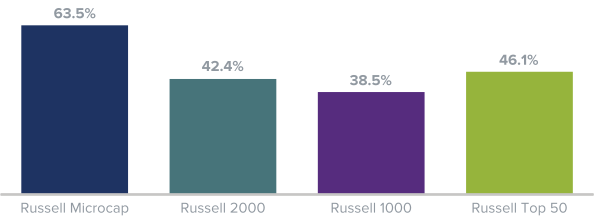
Source: Russell Investments. Past performance is no guarantee of future results. Please note that an investor cannot invest directly in an index. Unmanaged index returns do not reflect any fees, expenses or sales charges.
How much of an impact do you think the two interest rate cuts were on small-cap returns?
Chris Clark: I think they were very impactful. We’ve so far sort of deconstructed the components of the rally, though another key component was the strength small-caps often exhibit in the early stage of a falling rate cycle. Jim mentioned how it was a low-quality rally, which means that those more highly levered, higher capital intensive businesses tended to do better because of the relief they’re getting in their capital structure from lower rates.
Francis Gannon: That’s right. However, I don’t think rates will play as large a role in 2026. I think earnings strength and quality will drive performance, especially within small-cap, as part of a broadening market.
Jim Harvey: To Frank’s point, our team began talking about this a year ago. We thought that 2025 was going to be the year where earnings would really begin to shine for small-caps, but it now looks like 2026 could really be the year for that. In terms of interest rates, they’re always going to be a backdrop of the market, and at times I think people get overly fixated on them. It is good news, though, that rates are headed in the right direction—but it’s really more about the level. Many smaller companies were unable to refinance at a decent rate over the last few years because there’s been so much uncertainty in the market and economy. But I think we’re moving away from the uncertainty narrative. I don’t think we need rates to continue to decline into 2026, though I think they probably will. I agree with Frank that earnings growth is going to be a much more significant driver of small-cap performance in 2026.
Do you think that rates need to keep falling for small-caps to outpace large-caps in 2026?
Lauren Romeo: I don’t think so. US small-caps’ current absolute valuations remain reasonable, and the case for their reversion to the mean of relative valuation versus large-caps remains compelling. Small-caps also only recently emerged from an earnings recession that lasted more than two years. The return to small-cap earnings growth, and, importantly, at a projected pace that is much faster than that of large-caps, could prove to be the key catalyst for sustained outperformance in 2026.
Do you think micro caps, which have been the best performing asset class since the April lows, will continue to do well in 2026?
Jim Harvey: Micro-cap returns are often a barometer of risk. So to the extent that the market continues to be comfortable with liquidity and a willingness to take risk, micro-caps should do well. There are some higher-quality micro caps, and if the market continues to broaden out, more micro caps could participate.
Lauren Romeo: Given micro-caps’ rapid appreciation and valuation multiple expansion in 2025, my guess is that the pattern of past small-cap rallies from troughs will repeat itself, which would mean that the leadership baton within small-caps passes from more speculative stocks to more established, quality small-cap companies with proven, durable business models. As Jim said, there are quality and emerging quality micro-caps that can benefit from that leadership shift.
Do you all see earnings as the key to small-cap capturing sustained market leadership?
Francis Gannon: Definitely. I think we’ll also begin to see a rotation in the market to more broad-based performance. Jim and Lauren can probably address this better, but I think leadership is going to go shift from the companies that are supplying artificial intelligence (AI), to the beneficiaries of AI, and that's going to include a lot of businesses beyond the mega-cap names. Companies are just beginning to scratch the surface in terms of productivity enhancements and margin expansion, so that’s another dimension to the earnings story.
Jim Harvey: I think that's a really good point. The market has favored the obvious AI beneficiaries right out of the gate, but that’s going to change. In fact, we own companies that have already benefited from this early phase. These are companies that supply components or help build the power plants, help build out the grid, build the infrastructure, and all the other technologies and industrial requirements to make AI happen. This path is going to continue, to Frank’s point. And the good thing about that, I think, is that certain companies that appear poised to benefit have been beaten down because of this idea that AI is going to replace everything. So you have consulting companies and software businesses that have just been taken down. But we're talking to many of them and doing a lot of research and analysis. We think a new narrative will emerge that shows that these companies are actually beneficiaries of AI and are likely to see improved profitability. We’ve seen a similar dynamic before within small-cap, where there are pockets of the market that are really beaten down before other investors realize that these companies could be well positioned to benefit from a new technology and these stocks tend to rebound nicely.
Small-Cap’s Estimated Earnings Growth is Expected to Be Higher Than Large-Cap’s in 2026
One-Year EPS Growth
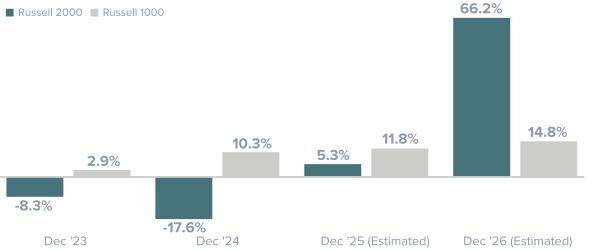
Source: FactSet. Past performance is no guarantee of future results. Earnings per share (EPS) is calculated as a company’s profit divided by the outstanding shares of its common stock. The EPS Growth Estimates are the pre-calculated mean two-year EPS growth rate estimates by brokerage analysts. Estimates are the average of those provided by analysts working for brokerage firms who provide research coverage on each individual security as reported by FactSet. All non-equity securities, investment companies, and companies without brokerage analyst coverage are excluded.
How large a role is AI playing?
Lauren Romeo: To quote Mark Twain and echo what Frank and Jim have said, “During the gold rush, it’s a good time to be in the pick and shovel business.” OpenAI and its competitors generate headlines almost daily about the billions of dollars they or their ecosystem partners have raised to fund continued investment in AI models, computing power, data center capacity, etc.
There are companies that have already reaped the benefits of this spending since they provide differentiated products or services that are key enablers of AI’s evolution and the buildout of AI-related infrastructure. A few examples include a duopoly provider of advanced probe cards that are essential for testing complex high bandwidth memory chips and GPUs, a critical infrastructure products producer that is a dominant national provider of highly engineered utility structures that are required for utilities to harden their grids and expand higher voltage transmission in the face of rising load growth (in part from AI data centers), a specialty infrastructure services provider that is the scale player in site preparation for mission critical construction projects such as data centers and semiconductor fabs, and a premier engineering and consulting firm that brings domain expertise to clients incorporating machine learning and AI into their systems and products, and helps address the challenges and disputes that may arise.
Do you think there’s an underexplored element in the AI story of certain companies that are being left for dead that actually will benefit from AI?
Jim Harvey: We’ve seen that dynamic in IT services companies—which have historically done very well during periods of technological disruption. This is probably the third or fourth phase of technological disruption that we’ve seen since I've been in the business. In each case, these IT services companies have come back better and stronger. The more recent cases are particularly fascinating because the market is saying that there's just no need for enterprises to need help figuring out AI, which just sounds crazy to me. Now, the business models might change a little bit for these companies; they might need fewer humans, which is understandable, but these companies have been investing in AI and these types of capabilities for a decade, so we think they are perfectly positioned to go out and help enterprises. But if you look at the stock prices, market does not agree with us.
With so much attention being devoted to AI, what less hyped-up areas of the market do you find promising?
Lauren Romeo: We focus on durable, high ROIC business models that are selling for what we think are reasonable valuations. Over the last few months, we’ve found reasonably valued companies with these characteristics in several sectors, such as consumer staples, and in diverse industries such as commercial and professional services, transportation, and capital markets.
Jim Harvey: We’ve recently added a few consumer discretionary names that appear to have been overly punished on tariff concerns. One issue that really has not received a lot of press is that the fate of tariffs is in the hands of the Supreme Court, and we’re supposed to hear about their decision shortly. This could be a market moving decision if the Court rules that that tariffs in their current form are illegal and potentially orders refunds, which could be a windfall for many companies and may help shift the attitude of consumers, which continues to be negative even as spending has been pretty robust. The potentially positive effects of the “Big, Beautiful Bill” are also not really being talked about much, although most of our companies have started talking about it over the last two most recent quarters. I think the impacts of tax relief and spending incentives are really going to hit throughout 2026, and small-caps could be significant beneficiaries.
We’ve also increased activity in energy and areas in health care beyond biopharma, which really dominated small-cap performance in 2025, and those areas where we’ve seen companies benefiting from AI-related spending. And to the extent that there’s going to be a broadening out of returns, we think we’re pretty well positioned to capture that.
With private equity, alts, and dual shares increasingly touted as investment options for ordinary retail investors, what do you think gives small-cap an advantage over these options?
Lauren Romeo: I’d say that over the long term, quality small-caps—for example, those with high returns on invested capital (ROIC), little debt, and proven management—have historically offered investors attractive compound annualized returns with less risk than the benchmark, but also greater liquidity, less leverage, and lower fees than private equity investments.
Small-caps as a whole have also been out of favor relative to large-caps for over a decade, which has created significant reversion to the mean potential for the asset class on both valuation and performance. Conversely, in private capital, particularly private equity, returns may have peaked given the flood of fundraising and new competition over the past decade, the normalization of interest rates, and delayed exits for portfolio holdings. As Frank has discussed, small-caps are benefiting from private equity’s “exit problem,” and we have seen acquisition of private equity-backed companies in 2025 at multiples below their own and much lower than their industry averages.
Finally, while the latest data shows global private equity “dry powder” down over 5% from its peak, there is still over US$2.1 trillion of uncommitted capital. Some portion of that will likely be put to use, with publicly traded companies, including small-caps, continuing to be a source for private equity acquisitions. We believe that companies in the quality universe remain attractive targets because they possess the financial and business model traits consistent with those sought by private (and strategic) investors. The high percentage of unprofitable small-cap companies within the Russell 2000 Index often gets the headlines. However, it obscures the large pool of high quality small-caps that consistently generate above-average returns on invested capital, solid free cash flow, along with strong balance sheets. Like their large cap siblings, these small-cap standouts have unique and sustainable competitive advantages that enable them to compound shareholder value at attractive rates of return via investment back into the business or inorganic opportunities.
The US economy continues to show mixed signals. What are your thoughts on the economy, and how is this uncertainty affecting portfolio positioning?
Jim Harvey: I’m pretty bullish on the economy. We have the World Cup coming to North America, with 11 American host cities in each region of the country. That’s creating and will continue to create a lot of economic activity all over the country, including large numbers of tourists who’ll be visiting to see the games. We also have the 250th anniversary of American independence in July, which is another feel good moment for the United States. I think these events should help shore up consumer confidence, which is another reason why we’ve been adding names in the consumer discretionary sector.
Chris Clark: Picking up on Jim’s points, we could have a Goldilocks economy and market in 2026. The combination of government spending, falling inflation, lower rates, a housing recovery, and earnings growth can really keep share prices climbing and the economy growing. There are some obvious geopolitical situations that can stress growth, especially in Venezuela and Ukraine, but there is a lot that can go right over the next 12 months.
Lauren Romeo: One nice thing about the business buyer’s approach is that it requires us to be business analysts, not macroeconomists. While we understand how various economic factors can impact each our holdings, we primarily evaluate companies on their long-term, through-cycle (that is, peak and trough) cash flow power. There is often an “all-weather” aspect to quality companies. Their strong balance sheets and relatively predictable free cash flow generation allows them not just to weather tough economic periods, but to go on the offensive and take market share from or acquire weaker competitors. In more historically typical periods of economic growth, quality companies tend to outgrow their markets as they are often providing unique and differentiated services or products that are critical to their customers’ success or enable secular demand tailwinds.
Francis Gannon: I think people are not yet focusing on one important aspect of the federal budget bill, which now allows for 100% depreciation and could therefore jump start a robust capital expenditure (capex) cycle in 2026. It’s going to be interesting to see what companies were doing when fourth-quarter earnings are reported. We could also see corporate earnings tax rates come down pretty dramatically, which I think is going to be very beneficial to small-caps. Throw deregulation on top of that, along with one or two more Fed cuts, possible tariff relief, reshoring, and the earnings story and I think you’ve got a really healthy economy that should also improve the already solid state of small cap performance.
What is your outlook for 2026?
Jim Harvey: We regularly review our value themes, which helps us frame why we continue to hold our positions. We’ve been finding that there are just a lot of companies that do not seem valued properly based on their earnings potential, and we think that much of that potential is going to be recognized by the wider market in short order. One of the biggest things we’ve seen is that, even with the Russell 2000 Index flirting with new highs, there are still segments of the market that have not been carried along with it, which is something that we usually see during rallies. There are almost always interesting opportunities at what we think are bargain basement prices. I talked about health care earlier, and that sector offers a good example of how we see the year ahead. Within small-cap, there are a lot of companies outside the biopharma complex that look very interesting to us. We think there’s likely to be a rotation in the sector, and our job is to try to get ahead of it so our investors can potentially reap the rewards down the road.
The biggest of our four investment themes right now is undervalued growth, where we see a lot of companies that screen well based on low price to sales and price to book. We’ve been talking to management teams and analysts who share our view that these businesses look ready to grow, though the market doesn’t yet agree, which gives us plenty of opportunities to buy what we think are terrific growth companies at really low prices.
Lauren Romeo: Given the sharp multiple expansion among lower quality small-cap companies, such as those with low return on invested capital (ROIC), no profits, and/or more speculative profiles, it would not be surprising to see small-cap leadership again follow its historical pattern and transition to higher quality companies. We believe many of our portfolio companies created measurable economic value in 2025 that was not fully reflected in their stock prices. This valuation disconnect, along with accelerating growth, underpinned by durable business models with identifiable, high return reinvestment opportunities, should drive further compounding of value, creating an attractive setup for quality small-caps in 2026.
Francis Gannon: I’m very constructive because we appear to be seeing an almost perfect amalgamation, if you will, of attractively cheap valuations and high company quality. When you put that together, you wind up with exposure to several wonderful attributes—which Lauren and Jime have each talked about. I would add that qualities such as entrepreneurial growth, innovation, automation, and long-term compounding are yet to be recognized by the overall market in many instances. That’s created a very appealing opportunity, which leads me to believe 2026 could be quite an exciting time for the asset class, and active small-cap management in particular.
Definitions
The Russell 2000 Index is an index of domestic small-cap stocks that measures the performance of the 2,000 smallest publicly traded US companies in the Russell 3000 Index.
A low return on invested capital (ROIC) generally indicates a company is not efficiently using its capital to generate profits and may be destroying value for investors. A company with low ROIC often struggles to sustain long-term growth and is at a competitive disadvantage.
A Goldilocks economy is an ideal, but typically temporary, macroeconomic state that is "just right"—neither too hot (causing high inflation) nor too cold (risking recession).
“AI pick and shovels” refers to the companies and sectors that provide the foundational tools, infrastructure, and services necessary for the development and operation of AI, rather than the consumer-facing AI applications themselves.
Capital expenditure (capex) refers to investment spending in long-term assets (fixed assets). These expenditures include new buildings, machinery, and other equipment needed for an organization's day-to-day operations. Most companies use capex financing to fund their long-term investments.
WHAT ARE THE RISKS?
All investments involve risks, including possible loss of principal. Past performance is no guarantee of future results. Please note that an investor cannot invest directly in an index. Unmanaged index returns do not reflect any fees, expenses or sales charges.
Equity securities are subject to price fluctuation and possible loss of principal.
Commodities and currencies contain heightened risk that include market, political, regulatory, and natural conditions and may not be suitable for all investors.
Small- and mid-cap stocks involve greater risks and volatility than large-cap stocks.
US Treasuries are direct debt obligations issued and backed by the “full faith and credit” of the US government. The US government guarantees the principal and interest payments on US Treasuries when the securities are held to maturity. Unlike US Treasuries, debt securities issued by the federal agencies and instrumentalities and related investments may or may not be backed by the full faith and credit of the US government. Even when the US government guarantees principal and interest payments on securities, this guarantee does not apply to losses resulting from declines in the market value of these securities.
Investments in fast-growing industries like the technology sector (which historically has been volatile) could result in increased price fluctuation, especially over the short term, due to the rapid pace of product change and development and changes in government regulation of companies emphasizing scientific or technological advancement or regulatory approval for new drugs and medical instruments.
Any companies and/or case studies referenced herein are used solely for illustrative purposes; any investment may or may not be currently held by any portfolio advised by Franklin Templeton. The information provided is not a recommendation or individual investment advice for any particular security, strategy, or investment product and is not an indication of the trading intent of any Franklin Templeton managed portfolio. Past performance does not guarantee future results.
Any data and figures quoted in this article sourced from Russell Investments, FactSet, Bloomberg and Reuters.
Important data provider notices and terms available at www.franklintempletondatasources.com. All data is subject to change.
WF: 8156033
