
CIO VIEWS
CONTRIBUTORS

Sonal Desai, Ph.D.
Chief Investment Officer, Franklin Templeton Fixed Income
Investing is tough these days—but I’d still rather have my job than the Federal Reserve’s (Fed). The June policy meeting of the Federal Open Market Committee (FOMC) highlighted just how complex the central bank’s challenge is.1 In part it’s because the economic environment has become more complex, but in part it’s the Fed’s own fault.
The Fed’s meeting came off as more hawkish than markets expected: the median Fed funds forecasts (the “dots”) now show two interest-rate hikes in 2023 (compared to none in March); the tone on the growth and employment outlook was more upbeat; the core consumer price index (CPI) forecasts for 2021 and 2022 were raised to 3.0% and 2.1%, respectively.
But what was most striking was 1) a greater degree of humility in acknowledging the uncertainty in an outlook dominated by unprecedented shocks and policy moves; but 2) a still strong reluctance to start adjusting the policy stance.
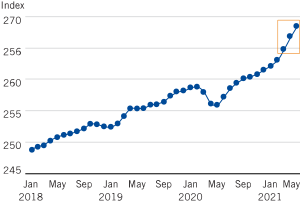
Assessing the current inflation rebound is hard. The Fed insists it’s temporary, mostly due to base effects, and projects inflation coming down on target by next year. But this time their assessment was a bit more humble. After all, if there is something that can be foreseen is base effects—we do know the past. And yet, the May US inflation number surprised to the upside..
INFLATION IS ACCELERATING BEYOND PRE-PANDEMIC PATH
US CONSUMER PRICE INDEX (CPI), SEASONALLY ADJUSTED (January 2018—May 2021)
Source: Bureau of Labor Statistics (BLS). As of May 31, 2021.
I do think there are more durable pressures at work here, as I argued in my LinkedIn newsletter.2 Stanford’s John Cochrane noted in a recent presentation that if you look at the price index level, you can see an acceleration that goes beyond making up for the decline of a year ago. It’s not just going back to the pre-pandemic path, it seems to be heading on to a steeper one.
The Fed now acknowledges inflation risks are skewed to the upside. But it still sees them as worth taking to get back to full employment. And here comes another challenge: where is full employment now? In the short term, we have been focusing on the labor shortages created in all likelihood by generous enhanced unemployment benefits; even with a high unemployment rate, employers have a hard time filling vacancies. This is a teachable moment on the power of incentives, but it should fade over the coming months as the extra benefits expire.
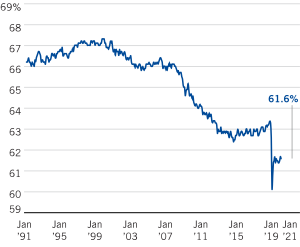
There is a bigger issue, however: the pandemic has given a serious knock to the labor force participation rate—the percentage of working-age people who are either working or looking for a job. During 2017-2019, the US participation rate had begun to slowly reverse its previous prolonged deep decline. Then between February and April 2020, it collapsed by more than three percentage points; and after a partial rebound, it’s been treading water for the last 12 months.
PANDEMIC HAS IMPACTED LABOR FORCE PARTICIPATION
US LABOR FORCE PARTICIPATE RATE (%), SEASONALLY ADJUSTED (January 1991—May 2021)
Source: Bureau of Labor Statistics (BLS). As of May 31, 2021.
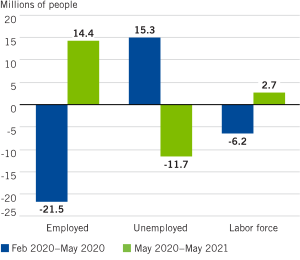
Or to look at it a different way: between February and May last year, as the economy got locked down, employment dropped by 21.5 million people; of these, 15.3 million joined the ranks of the unemployed, and 6.2 million dropped out of the labor force. Since then, we have reversed three-quarters of the increase in unemployment (11.7 million), but less than half of the decline in labor force (2.7 million), yielding a two-thirds recovery of lost employment.
RETURNING TO WORK?
US JOBS RECOVERY (MILLIONS OF PEOPLE) February 2020—May 2020 vs. May 2020—May 2021
Source: Bureau of Labor Statistics (BLS). As of May 31, 2021.
In other words, the pace at which people are coming back into the labor force has been especially disappointing, and flags the risk that some of the decline in labor force participation might be permanent. Some people might have opted to retire early. Of even greater concern is the decline in the participation rate for “prime working age” men, those aged 18-54 who constitute the bulk of the labor force: it has recovered only half of the three percentage point drop recorded at the beginning of the pandemic and has also stagnated for the past year.
Academics have pored a lot of effort in trying to understand what’s been driving the participation rate—with mixed results. But the key takeaway is this: over the past 20 years, something has been pushing participation down, both overall and for prime working-age men. The decline accelerated between 2009 and 2014, reflecting a slow economic recovery and wider recourse to social benefits after the global financial crisis; and the hottest labor market in living memory,(in the run-up to the pandemic) had only managed to boost participation by less than half a percentage point.
While acknowledging the uncertainty, Fed Chair Jerome Powell expressed confidence that “we are on a path to a very strong labor market…that shows low unemployment, high participation.” Let’s hope. But the participation rate has been treading water for the last 12 months. If its recovery proves as slow and limited as it was the last time around, full employment might be depressingly closer than we thought.
When Powell says we’ll get back to low unemployment and high participation, does he mean that the Fed’s full employment target is a 3.5% unemployment rate with the participation rate back to pre-pandemic levels above 63%? That might be well be a very unrealistic target.
The Fed now acknowledges the upside inflation risks and Powell said they have started to talk about an eventual tapering of asset purchases – though they still want to see substantial further progress towards their goals. This week’s meeting was an important step forward; the change in the inflation forecasts and interest rate expectations by FOMC members have shifted the tone of the discussion, and reminded investors that down the line, tapering is going to happen. But getting the timing right will be hard, given the uncertainty in inflation and employment trends. The complicating factor which makes this a very high-stakes game is the exceptionally loose stance of monetary policy—and this is the Fed’s own doing. If the recovery keeps roaring and inflation pressures persist, monetary policy will look increasingly out of line with fundamentals; executing a smooth course correction without either spooking investors or letting the economy overheat too much will be the hardest high-wire balancing act we’ve seen in a long time. The markets are watching.
Meanwhile, even as 10-year US Treasury (UST) rates have nervously moved up on the Fed’s news, the challenge for fixed income investors remains how to generate yield without being forced further and further out on the risk spectrum. It can be done. Funds have kept coming into the municipal bonds market, and the Financial Times warns that “junk” municipal bonds in particular are attracting too much interest.3 But if you do your homework, the municipal bond universe offers plenty of opportunities for attractive yield pickup on strong quality issuers—our Franklin Templeton Municipal Bonds team has its own track record to prove how deep research in this area pays off.
The high yield corporate bond sector also offers some very interesting opportunities, despite the continued compression of spreads. The average quality of the index has risen, as the pandemic flushed out some of the weakest credits and at the same time has pulled in some “fallen angels” from the investment grade level. BB-rated companies now account for about 54% of the ICE BofA US High Yield Index; that’s a five percentage points increase from early last year.4 When you put that together with a strong economic growth outlook, the high-yield sector looks quite attractive—always with a watchful eye to individual name quality, of course.
And of course, one of our underlying main strategy themes remains to limit duration: whether the Fed ratchets up its rhetoric further in the coming months or not, risks to inflation and yields seem squarely skewed to the upside. The Fed sounds confident and in control, but still, I would not want to be in their shoes.
ENDNOTES
-
Source: US Federal Reserve. June 15-16, 2021 FOMC meeting.
-
Source: Mind over Markets LinkedIn Newsletter, by Sonal Desai. “The UBI-quitous inflation question”, June 9, 2021.
-
Source: Financial Times. “US investors hunt for yield in junk-rated municipal debt”, June 16, 2021.
-
Source: ICE Data Indices, LLC. As of May 31, 2021. Indexes are unmanaged and one cannot directly invest in them. They do not include fees, expenses or sales charges.
WHAT ARE THE RISKS?
All investments involve risks, including possible loss of principal. The value of investments can go down as well as up, and investors may not get back the full amount invested. Bond prices generally move in the opposite direction of interest rates. Investments in lower-rated bonds include higher risk of default and loss of principal. Thus, as prices of bonds in an investment portfolio adjust to a rise in interest rates, the value of the portfolio may decline. Changes in the credit rating of a bond, or in the credit rating or financial strength of a bond’s issuer, insurer or guarantor, may affect the bond’s value. Actively managed strategies could experience losses if the investment manager’s judgment about markets, interest rates or the attractiveness, relative values, liquidity or potential appreciation of particular investments made for a portfolio, proves to be incorrect. There can be no guarantee that an investment manager’s investment techniques or decisions will produce the desired results.