
Our Core Enhanced Equity strategies are designed to sit between traditional active and passive approaches — offering access to systematically captured active conviction, while remaining cost‑competitive with other enhanced index and factor‑based solutions.
Rethinking how portfolios are built
Finding the right balance between cost and returns is not always easy.
Equity portfolios are expected to do a lot. They need to be diversified, cost-aware and reliable over time – while keeping pace with changing market conditions.
Investors approach this in different ways. Some rely on broad market exposure, which keeps costs low but includes everything, regardless of quality. Others use factor-based strategies, which offer a more selective, cost-efficient approach and group stocks based on shared characteristics. And many turn to active managers for more selective, high-conviction ideas, accepting a higher cost in return for that insight.
Four factors are standard. Conviction is not.

Our Core Enhanced Equity strategies are designed with that balance in mind.
They start with established factors – quality, value, sentiment and alternative – that have helped explain market behaviour over time. We then add a fifth element: conviction.
Conviction reflects how strongly fund managers back their ideas. It shows up in how portfolios are built – not just which stocks are held, but how much is invested in each one.
We look at how fund managers allocate capital to identify where those strongest views lie. We then bring that insight together with established factors in a systematic, benchmark-aware approach.
The resulting strategies aim to keep the discipline and consistency investors value, while adding an extra layer of potential alpha drawn from active decision-making.
Adding conviction to a structured approach
Traditional factor approaches are efficient but they do not distinguish between strong and weaker ideas. Conviction adds that dimension by identifying where active managers commit capital with greatest confidence.
By integrating those signals alongside established factors within a disciplined framework, the strategies allow insight to be expressed more clearly – without compromising the structure and predictability expected of core equity allocations.
Understanding the fifth element
Two short articles exploring why conviction matters and how it is identified, extracted and applied.

Why conviction matters in factor investing
A closer look at the role of conviction and why it is not fully captured by traditional approaches.

Capturing conviction: from portfolios to signal
How the strategy extracts conviction from fundamental portfolios and turns it into a usable signal.

Designed for a core role in portfolios
Market exposure plus differentiation
The strategies are designed to stay closely aligned to broad market exposure, while introducing a differentiated source of return.
Our Core Enhanced Equity strategies balance factor exposures with conviction, while maintaining tight control over risk and diversification. The portfolios are constructed to behave as investors would expect from a core allocation, without taking large or unintended risks.
The result is: strategies that fit naturally within a portfolio – familiar in structure, but broader in the sources of return they draw on.
Cost matters in core portfolios
Core allocations are typically held for long periods, which means costs compound over time. Any additional source of return needs to be delivered efficiently.
Long-term cost efficiency matters
Positioned between active and passive
By embedding conviction within a quantitative framework, the strategy avoids the cost structure of fully active management, while retaining a disciplined approach to risk and diversification.
Disciplined conviction without active costs
Ongoing charges vary by fund and share class and currently range from approximately 0.09% to 0.30%. Further details are available in the relevant fund documentation.
Explore our funds
Our Core Enhanced Equity range offers a set of strategies designed to support different regional and global equity allocations.
FTF Franklin Core UK Equity Enhanced Index Fund
FTF Franklin Core Europe ex UK Equity Enhanced Index Fund
FTF Franklin Core US Equity Enhanced Index Fund
FTF Franklin Core Global Equity Enhanced Index Fund
Backed by deep expertise
Managed by Franklin Templeton Investment Solutions
Our Core Enhanced Equity strategies are managed by Franklin Templeton Investment Solutions (FTIS), a global multi-asset team with deep experience in quantitative research, portfolio design and systematic equity investing.
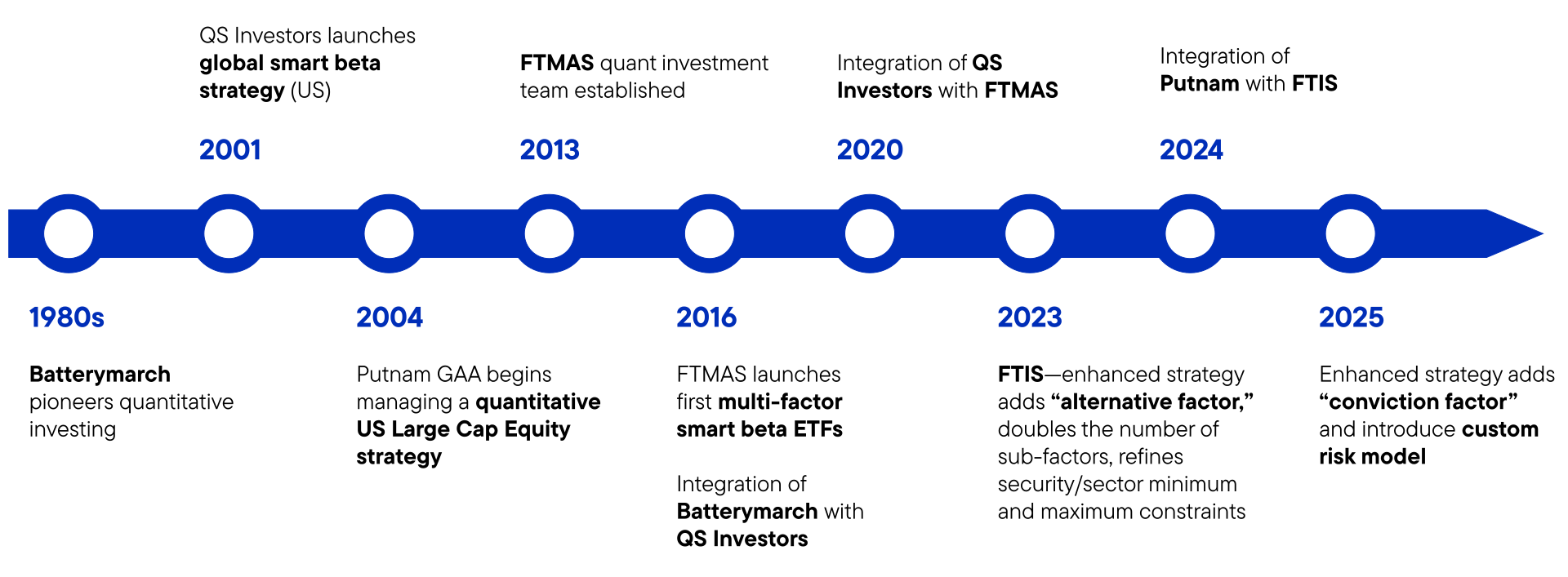
The team brings together deep expertise across asset classes, regions and investment styles – supported by a legacy of innovation that dates back to the 1980s, and they’ve been refining their approach ever since.
Today, the team includes over 90 investment professionals across 12 global offices, managing over US$100 billion in assets.1
Portfolio management team for our core enhanced equities

Brett E. Risser
Senior Vice President, Head of Quantitative Equity Portfolio Management
Jacqueline Hurley Kenney, CFA
Senior Vice President, Head of Solutions Research
Adrian Chan, CFA
Senior Vice President, Head of Quantitative Investments
Lisa Wang, CFA
Senior Vice President, Head of EMEA Investment Strategy
FAQs
A Core Enhanced Equity strategy is designed to provide broad equity market exposure, similar to a benchmark, while seeking to deliver incremental outperformance through a systematic investment approach. It aims to balance consistency of returns with modest alpha generation within a controlled risk framework.
Passive strategies aim to replicate an index at low cost, while traditional active strategies take higher-conviction positions that can lead to greater deviation from the benchmark.
Core Enhanced Equity sits between the two—maintaining benchmark-like characteristics while introducing diversified, systematic sources of alpha.
A benchmark-aware approach is constructed to maintain similar risk characteristics to a reference index, with tight control over tracking error. This allows the strategy to function as a core holding, without introducing unintended factor, sector or regional biases.
Factor investing involves targeting specific characteristics—such as quality, value, momentum (sentiment), and others—that have historically been associated with excess returns over time.
These factors are grounded in both academic research and market behaviour, and can provide a systematic and transparent way to access long-term return drivers across equity markets.
The strategy incorporates established factors including quality, value, sentiment and alternative signals, which help explain differences in stock returns. These are combined in a diversified and risk-controlled manner to improve consistency of outcomes across market cycles.
Conviction captures the strength of active managers’ investment views, as expressed through their portfolio positioning—particularly stock weightings.
By systematically extracting this information, the strategy introduces an additional, differentiated source of return that is not typically captured by traditional factor models.
Generating consistent alpha typically requires combining multiple sources of return rather than relying on a single approach.
This can include blending factor exposures, maintaining diversification, controlling unintended risks, and incorporating high-conviction insights from active managers. Approaches that integrate these elements within a disciplined framework may improve the consistency of outcomes over time.
Risk is managed through a disciplined, benchmark-aware construction process, with diversification across factors and tight controls on tracking error.
The strategy also seeks to neutralise uncompensated risks—such as unintended sector, country or style exposures—ensuring that returns are driven primarily by intended sources of alpha.
Core Enhanced Equity is designed to sit at the core of an equity allocation, providing broad market exposure while enhancing return potential.
It can be used alongside passive and high-conviction active strategies to improve overall portfolio efficiency within a defined risk budget.
Combining factor and active investing allows investors to benefit from both systematic, research-driven return drivers and fundamental stock-picking expertise.
Factor investing provides consistency and diversification, while active insights can introduce differentiated sources of return. Integrating the two can create a more balanced and resilient approach to equity investing.