

CONTRIBUTORS

Francis A. Scotland
Director of Global Macro Research
The ripple of turbulence provoked by the February bond selloff could be a taste of what is to come later this year. If the vaccines are successful in putting the pandemic behind us, and the U.S. economy really starts to gain traction, it is possible that capital markets could truly start to rumble.
For Rising Yields, Pace Is Important
Most seem to agree that the cause of February’s market turbulence was the speed of the selloff in Treasuries, not the direction. Equilibrium yields and rates should go up as the economy reopens. Chinese 10-year yields renormalized to pre-pandemic levels by September 2020 because the domestic economy recovered quickly due to prompt control of the outbreak through strict social isolation compliance as only China could enforce. In the U.S., 10-year Treasury yields also finally renormalized to pre-pandemic levels last month, coinciding with the level of real gross domestic product (GDP) more or less regaining its 2019 high-water mark, at least based on the Federal Reserve Bank of Atlanta’s GDP Nowcast current quarter growth estimates.
That was essentially Federal Reserve (Fed) Chair Jerome Powell’s message in late February when he refrained from giving any sign of possible intervention in the bond market. With credit spreads near record lows, it is hard to make a case for any kind of restrictive financing conditions in the marketplace. So far, the rise in yields is in line with the restoration of pre-pandemic levels of activity in real GDP.
The bull story is that as long as yields increase gradually or at least in step with the pace of economic renormalization, capital should rotate from long-duration assets, like the big-cap growth stocks, into deep-value cyclical and small-cap equities while nominal GDP recovers. If for some reason the rise in interest rates is more rapid, there could be volatility. During late February, for example, the turbulence caused by the bond market was enough to pull the broad market lower, not just the big-cap growth stocks, at least briefly.
Factors Are Aligned For An Historic Boom
When considering what could create a more disorderly selloff in the bond market, a few things are worth noting:
- The Chinese bond market has been stable for almost six months since renormalizing. However, China’s macro policies have reversed. The People’s Bank of China (PBOC) raised rates 50 basis points late last year, fiscal policy has become a drag, the credit impulse is rolling over, and the renminbi (RMB) is up about 5% against the U.S. dollar. In contrast, U.S. policymakers keep adding more fuel to the fire as the economy recovers. The Fed wants the economy to run hot enough for inflation to overshoot 2% for a while. Meanwhile, the dollar is down about 5% from its starting point in 2020.
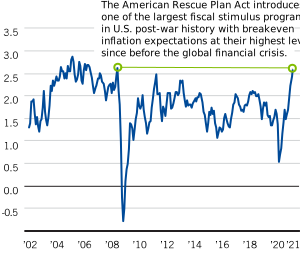
- The latest round of U.S. stimulus comes with the 5-year breakeven inflation rate at its highest level since the global financial crisis (GFC), after rebounding from its lowest level a year ago. Put another way, the CARES Act $2 trillion fiscal relief program came with the economy in a free fall and breakevens at their lowest level since the GFC. The American Rescue Plan Act of 2021 is almost of the same magnitude with the economy in a V-shaped recovery mode and breakeven inflation rates breaking out.
U.S. Five-Year Breakeven Inflation Expectations
%, As of 3/11/2021
- Even some establishment Keynesian economists who support Treasury Secretary Janet Yellen’s call to “go big” argue that the American Rescue Plan Act of 2021 might be too big, a view debated in a recent Markus Academy webinar with Lawrence Summers and Paul Krugman, hosted by Princeton University on February 12, 2021.
- More fiscal stimulus is expected later this year in the form of a multi-trillion-dollar infrastructure spending program that the Biden administration is developing under the Build Back Better plan.
- Credible private sector forecasters are scrambling to revise their growth outlooks higher with many seeing a hiring boom driving unemployment to pre-pandemic rates sometime in 2022. Government agencies, on the other hand, appear to remain flat-footed on the speed of the rebound unfolding. The Fed is notoriously out of kilter with market expectations. The “dot plot” rate profile consistently exceeded market expectations for most of the period since the GFC. Now, the discrepancy has flipped with the market looking for rate increases well in advance of the timeline indicated by the central bank’s forward guidance.
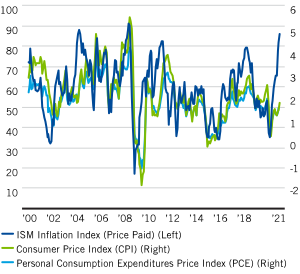
- The Fed has remained calm about the inflation outlook, yet a variety of inflation indicators are pointing higher. Core PCE-based inflation should easily take out the 2% rate based on its historical correlation with the 5-year breakeven inflation rate.
U.S. Inflation Indicator Points to Higher Inflation
% (Left), Annual % Change (Right), As of 1/31/2021
None of these factors take into account the most important positive macro-influence on the economy, which is the reopening of the economy if the vaccines are effective and widely adopted.
Dr. Anthony Fauci, director of the U.S. National Institute of Allergy and Infectious Diseases, often threw a wet blanket on the former administration’s pandemic comments last year when he felt they were too optimistic. His view changed significantly at the end of 2020 on news of the vaccines, and he openly predicted that America’s football stadiums could be full in September. If that prediction proves true, it will represent a sea change in peoples’ behavior and be a major positive impulse to economic growth, to understate the case for an historic boom.
What Is Keeping Bond Yields In Check?
What is keeping bond yields in check considering these risk factors? One of the most popular explanations is the Fed and financial repression. The main argument supporting this view is that the scale of the Fed’s balance sheet expansion has roughly matched net new Treasury issuance last year, which is what one would expect from a Modern Monetary Theory (MMT) approach.
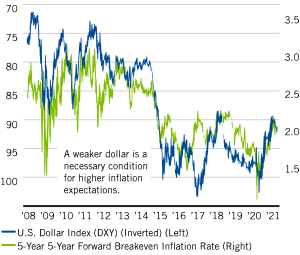
But the story is more complicated. There is no denying the scale of Fed Treasury purchases. Yet, previous quantitative expansion of the balance sheet has been associated with rising bond yields, which is the case again. In addition, the dollar should be a lot weaker if the Fed is artificially depressing real interest rates below equilibrium. Instead, the dollar is off a measly 5% from where it started in 2020 despite trillions in balance sheet expansion, an historic regime change in U.S. monetary policy, and budget deficits to kingdom come. The relative stability of the greenback in the face of these developments speaks to an underlying enormous demand for dollar liquidity. As Chart 3 shows, the case for higher long-term inflation expectations and bond yields seems on hold without a significantly weaker dollar.
The U.S. Dollar and Inflation Expectations
Index (Left), % (Right), As of 3/11/2021
In my view, the demand for dollars is coming from the private sector. U.S. rates remain attractive relative to other countries, which encourages foreign capital flows into dollars. However, the biggest source of dollar demand comes from U.S. domestic capital. The collapse in the velocity of money, the surge in bank deposits, and dramatic increase in household savings all point in the direction of an extraordinary increase in the demand for dollar liquidity. Most of this private sector money has supported Treasuries. Bank deposits soared by several trillion, which banks used to buy Treasuries and then sold to the Fed. Those Treasury securities have been replaced with excess reserves. The Fed effectively has taken in notes and bonds in exchange for Treasury bill-like instruments, called excess reserves. These excess reserves are not money in the usual sense since they can only be held by commercial banks, and they remain dead money to the economy unless loan demand picks up. This action to accommodate the public’s demand for dollar liquidity was able to stop and then reverse the move higher in the dollar last March. However, the net effect has left the dollar only marginally lower than it was at the start of 2020 and bond yields at about the same level.
Confidence, Fed Reaction Are Key To What Comes Next
Unlocking this extraordinary demand for U.S. liquidity is the key to gauging when the next leg of the U.S. bond bear market will take place, and if/when the dollar is ready to swoon. Market drivers will be confidence and the reaction of the Fed. It was fear of the pandemic and government-ordered lockdowns that drove the demand for liquidity in the first place. It makes sense that relief over the pandemic’s end and green lights from governments will be the keys to unwinding some or all of this unusual dollar demand. How the Fed reacts to this development will be an important part of the story concerning bonds and the dollar. If it stays true to current guidance, failure to react to a drop in the demand for dollars without curbing balance sheet expansion will amount to another flush of stimulus. Eventually, the Fed will likely react sensibly but its response will be late. If Dr. Fauci is correct, and the stadiums are full in September, the biggest rumbles in the latter part of the year may not be on the football field.
Subscribe for our latest Fixed Income updates
DEFINITIONS:
A credit spread is the difference in yield between two different types of fixed income securities with similar maturities.
Yield refers to the earnings generated and realized on an investment over a particular period of time.
Nominal GDP measures a country’s gross domestic product using current prices, without adjusting for inflation.
Credit impulse represents the flow of new credit issued from the private sector as a percentage of GDP. It is considered as the second derivative of credit growth and arguably the biggest driver behind economic growth.
A basis point (bps) is one one-hundredth of one percentage point (1/100% or 0.01%). Credit impulse represents the flow of new credit issued from the private sector as a percentage of GDP. It is considered as the second derivative of credit growth and arguably the biggest driver behind economic growth.
Keynesian economics is a macroeconomic economic theory of total spending in the economy and its effects on output, employment, and inflation. It was developed by the British economist John Maynard Keynes during the 1930s in an attempt to understand the Great Depression. It is considered a “demand-side” theory that focuses on changes in the economy over the short run.
The American Rescue Plan Act of 2021, also called the COVID-19 Stimulus Package, is a $1.9 trillion economic stimulus bill passed by the 117th United States Congress and signed into law by President Joe Biden on March 11, 2021, to speed up the United States' recovery from the economic and health effects of the COVID-19 pandemic and the ongoing recession.
Modern Monetary Theory (MMT), not widely accepted, has the following basic attributes: A government that prints and borrows in its own currency cannot be forced to default, since it can always create money to pay creditors. New money can also pay for government spending; tax revenues are unnecessary. Governments, furthermore, should use their budgets to manage demand and maintain full employment (tasks now assigned to monetary policy, set by central banks). The main constraint on government spending is not the mood of the bond market, but the availability of underused resources, like jobless workers.
The velocity of money is the rate at which money is exchanged from one transaction to another, and how much a unit of currency is used in a given period of time.
WHAT ARE THE RISKS?
Past performance is no guarantee of future results. Please note that an investor cannot invest directly in an index. Unmanaged index returns do not reflect any fees, expenses or sales charges.
Equity securities are subject to price fluctuation and possible loss of principal. Fixed-income securities involve interest rate, credit, inflation and reinvestment risks; and possible loss of principal. As interest rates rise, the value of fixed income securities falls. International investments are subject to special risks including currency fluctuations, social, economic and political uncertainties, which could increase volatility. These risks are magnified in emerging markets. Commodities and currencies contain heightened risk that include market, political, regulatory, and natural conditions and may not be suitable for all investors.
U.S. Treasuries are direct debt obligations issued and backed by the “full faith and credit” of the U.S. government. The U.S. government guarantees the principal and interest payments on U.S. Treasuries when the securities are held to maturity. Unlike U.S. Treasuries, debt securities issued by the federal agencies and instrumentalities and related investments may or may not be backed by the full faith and credit of the U.S. government. Even when the U.S. government guarantees principal and interest payments on securities, this guarantee does not apply to losses resulting from declines in the market value of these securities.