

CONTRIBUTORS

Andrew Ness
Portfolio Manager, Franklin Templeton Emerging Markets Equity
United Kingdom
Emerging markets valuation in context
Valuations are often cited as a reason for caution. It is true that emerging market equities have, at times, traded toward the upper end of their long-term price-to-earnings range. Periods of volatility can quickly shift that picture, and recent market weakness in some regions is a reminder that valuations do not move in a straight line. Viewed in isolation, headline multiples can appear uncomfortable—but as always, context matters.
Emerging market equities are often assessed against their own valuation history, which can make current multiples appear elevated. Viewed more broadly, however, emerging markets continue to trade at a discount to developed markets on several measures, even as the quality of the asset class has improved.1 Profitability has strengthened, balance sheets are more resilient, and earnings are increasingly driven by sectors with higher returns on capital and more durable growth profiles. Against that backdrop, today’s valuations look less like a warning sign and more like a reflection of a market that has matured.
Currency dynamics also deserve attention. Many emerging market currencies have benefited from improved external balances and reserve positions. While currency movements are never a one-way street, they no longer represent the persistent structural headwind they once did.
Valuation, in other words, needs to be assessed alongside quality and earnings durability. On that basis, current levels look less like a warning sign and more like a reflection of a maturing asset class.
Risk, redefined rather than removed
None of this is to suggest that emerging markets are risk-free. Episodes of geopolitical tension, currency volatility and commodity shocks remain part of the landscape. Political change, policy missteps and periods of volatility are part of the landscape. These episodes can feel acute when they occur, particularly when global energy prices, currencies or capital flows move abruptly. But they rarely affect all emerging markets in the same way. The difference today is that those risks are more differentiated and, in many cases, better understood.
Emerging markets are not a single macro trade. They are a collection of distinct economies at different stages of development, with varying policy frameworks and reform trajectories. That diversity can be challenging, but it also creates opportunity. Return dispersion in emerging markets is driven far more by individual companies than by countries or sectors, reinforcing the importance of understanding businesses at a granular level.2 It’s an asset class that rewards patience, selectivity and an appreciation of local nuance.
Looking ahead
When I think about the next decade, I am struck less by any single forecast and more by the direction of travel. Short-term cycles will continue to test conviction, but structural forces tend to play out over years, not quarters. United Nations population projections show that the growth of the global working-age population is increasingly concentrated outside advanced economies, as many developed markets face ageing or stagnant labour forces. At the same time, incomes are rising, consumption patterns are evolving, and technology is accelerating change across almost every sector.3
Where global growth is coming from
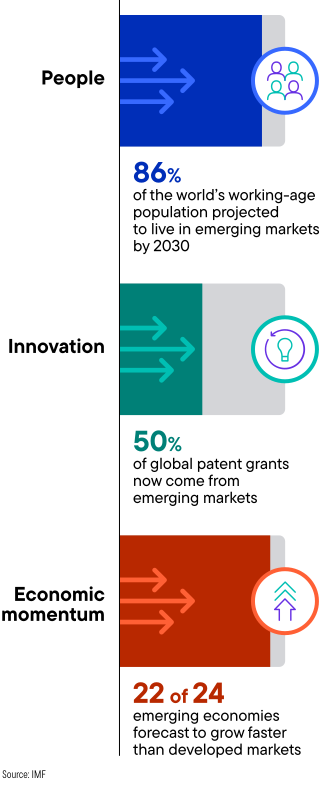
Behind those trends are people: families seeking better healthcare and education, entrepreneurs building businesses to meet local needs, and policymakers trying—sometimes imperfectly—to create more resilient economies. Those human considerations are easy to overlook in macro discussions, but they sit at the heart of long-term economic progress.
In my opinion, the implication is clear. Emerging market equities are no longer just a tactical allocation or a satellite exposure. They represent a structurally important part of the global opportunity set—one that looks increasingly relevant for portfolios built to withstand change and capture growth over time.
The case for emerging markets today isn’t about chasing momentum or ignoring risk. It is about recognising how the asset class has evolved, understanding where future earnings are likely to be generated, and aligning capital with economies that are shaping the next phase of global growth.
At this stage of the cycle, emerging markets deserve to be viewed not as peripheral, but as integral—less a frontier to be approached cautiously, and more a set of economies that are steadily, and convincingly, coming into their own.
Endnotes:
- Source: MSCI, FactSet, July 2015 - December 2025.
- Source: MSCI, Factset, based on stock returns. Important data provider notices and terms available at www.franklintempletondatasources.com.
- Source: United Nations, World Population Prospects 2024: Revision — official estimates and projections of global population and age structure through 2100 (Department of Economic and Social Affairs, Population Division).
