
Strong Risk-Adjusted Outcomes
- Peer-leading Sharpe & Information Ratios
- Asymmetric upside/downside market capture
A nimble, actively managed fixed income strategy that seeks high current income and capital appreciation by investing primarily in high yield corporate bonds. The strategy’s uniquely simple approach is defined by:
Strong Risk-Adjusted Outcomes
- Peer-leading Sharpe & Information Ratios
- Asymmetric upside/downside market capture
Execution Edge
Portfolio managers trade primarily in the secondary market and build a portfolio designed to provide maximum flexibility, especially amid times of distress in the high yield market
Contrarian, Long-Term Approach
Applies a complete market cycle investment horizon when evaluating new securities and invests based on levels of conviction, regardless of a security’s weight in the index
Our primary focus is on evaluating the underlying business fundamentals and credit risk of corporate securities. If we don’t know a bond well or don’t find its price attractive, we will not own it. This common-sense approach is surprisingly uncommon. Our process is disciplined but adaptable:
Pursuing consistent peer and benchmark outperformance over a full market cycle, the strategy’s intrinsic value-driven, contrarian approach is designed to capitalize on the opportunities created by a relatively inefficient market.
Our company analysis focuses on the fundamental economic drivers of the business and assesses whether there is adequate financial strength and flexibility to meet ongoing commitments. Avoiding deteriorating situations is critical to delivering consistent results. We evaluate not only the business prospects of the issuer but also whether the current price is compelling relative to risk.
Portfolio construction is a bottom-up process with highest weights assigned to companies where the team has the highest conviction. Familiarity with a company, degree of downside protection, the competitiveness of the price, and analyst conviction shape portfolio construction. The liquidity and expected volatility of a corporate bond are also important factors in portfolio construction. Given our long-term time horizon, we may invest in less liquid or more volatile securities when we receive adequate compensation. Opportunities may arise out of company-specific dislocations, industry dislocations, or market-wide dislocations. The important point is that we have conviction in our analysis, and we are willing to take advantage of dislocations that result in mispriced bonds.
Securities are purchased when we believe the yield and total return potential are compelling relative to asset and interest coverage and relative to other securities with comparable risk
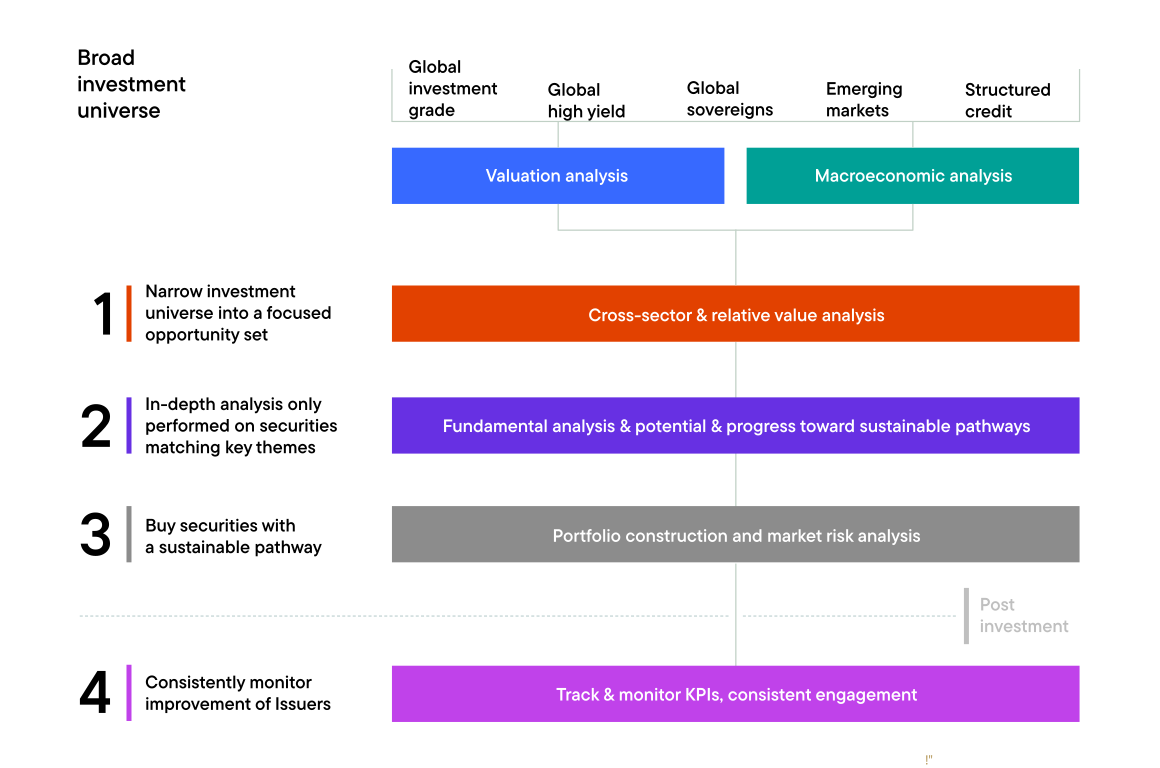
This is a general depiction of the investment team's methodology and may not reflect the exact investment process for any particular strategy.
The High Yield Strategy is managed by a long tenured team focused on fundamental credit analysis with the ability to leverage global macroeconomic insights and research as appropriate. Bill Zox is the portfolio manager on the strategy. Since 1986, our global experience has provided clients with investment insights and a range of differentiated fixed income, equity, and alternative solutions. We thrive in a culture of debate that encourages ideas, respects diverse viewpoints, and invites candid discussion. By challenging one another and conventional thinking, we make better investment decisions and create value for our clients.
Our mission is to deliver superior outcomes for our clients by encouraging independent thinking and challenging one another in a culture of integrity and mutual respect.

Portfolio Manager
Industry since: 2001
CFA® and Chartered Financial Analyst® are trademarks owned by CFA Institute.
Investments entail risks, the value of investments can go down as well as up and investors should be aware they might not get back the full value invested.


